Micromouse book
Categories
Recent Comments
Meta
Popular Posts
- Simple ADC use on the STM32 (3,934)
- STM32 Arm-Cortex bootloader (2,657)
- STM32 USART basics (2,535)
- All Japan Micromouse 2011 – finals (1,970)
- STM32F4 – the first taste of speed (1,615)
- Micromouse Book (1,532)
- Nokia 3410 LCD on the STM32 (1,264)
- CodeSourcery GNU Toolchain for the ARM on a Mac (1,097)
- Bit Banding in the STM32 (972)
- ARM STM32 JTAG (921)
Blogroll
-
Upcoming Events
-
Feb6Mon
-
Apr14Sat
-
Category Archives: News
Robot Cyclist
There is a long-held view that robots will, or should, exist to relieve human from the drudgery of everyday life. They should be used for tasks too tedious, or too dangerous for humans to perform. Now, at last, both goals … Continue reading
Posted in News
Leave a comment
Flying, flocking, and squirming robots at IROS
Last month, the International Conference on Robotics and Intelligent Systems (IROS) celebrated 50 years of robotics. If the program was anything to go by, there was more going on than a team of interested people could keep up with. New … Continue reading
Posted in News
Leave a comment
Dennis Ritchie obituary
The American computer scientist Dennis Ritchie, who has died aged 70 after a long illness, was one of the co-inventors of the Unix operating system and the C programming language. Unix and C provided the infrastructure software and tools that … Continue reading
Posted in News
Leave a comment
Site Rebuild
Having had enough of the pain of posting in Drupal I have moved the site back to WordPress. There will probably be a bit of random alteration going on for a bit until I tire of the novelty. A major … Continue reading
New camera time
Updated my camera today. The Casio Exilim EX-FH100 is a newer version of the EX-FC100. It does everything the older one did and then adds a few more features. Oh, and it is black. Somehow, that makes it better just for that reason.
So, what is different? First off, the lens can now do a 10x optical zoom compared to a 5x on the FC100. This is a real boon giving huge flexibility from a small camera. the wide angle setting is described as 24mm. I guess that makes it equivalent to a 24mm lens on a SLR camera. Images are fine at both extents.
With such a large zoom, you may worry about shake and blurry images. The inbuilt anti-shake seems to do a good job though. If that alone won’t fix up your pictures there are a couple of trick modes to help. For low light, there is a mode that uses the accelerometer to decide whether or not you are using a tripod. If it thinks the camera is still enough, it takes a longer exposure at a slower film speed for sharper results. If it thinks the camera is moving – hand held – then it takes several exposures and combines then to minimize blur.
The ability to take multiple images and combine the is used in several other modes as well.
The High Speed Best Shot mode takes aseries of images while the shutter is held down and then examines each one for the best faces. That is, smiling faces that are not blinking. This works really well in the few tests i have tried so far.
High Dynamic Range pictures are made possible in another mode that takes several images at different settings and combines them to allow you to see detail in shadows while retaining information in bright areas. While the effect looks a little unnatural on the screen, it more accurately reflects what you see. This too works very well.
I bought the original camera to allow high speed video at 210 frames per second for analysing micromouse movement. This feature is slightly enhanced by increasing the frame rate a little for each mode. thus, the new camera does 240 frames per secod rather than 210.
Image quality is supposed to be better as well. This afternoon, I took two pictures, one using the Casio and another using a Canon EOS 400D. Both set at wide angle, both on the default automatic settings. Both cameras have similar resolution Examining the Casio image at 1:1 size on the computer, showed the picture to look grainy and slightly rippled. I was quite dissapointed. Then I viewed the Canon image, also at 1:1. that was a bit of a surprise. The Canon image had very little visible noise but also seemed to be a lot softer in focus, lacking some detail. Viewed side by side so that the whole picture was visible, the Canon image seemed to lack clarity and had a poorer colour balance. On the other hand, fine details on a wall map, while being less sharp, appeared less distorted on the Canon. More test are needed but I am not at all unhappy with the overall image quality on the Casio. When a visitor to the office was asked which image came from the Casio and which from the Canon, he got it the wrongway round and was quite surprised to find he was wrong.
If you want one of these, click the image below to have a look on Amazon and get yourself one for Christmas.
Robot Football on the Gadget Show
While I could hardly be called a fan of football, at least getting robots to play the game gives it some character. A recent edition of The Gadget Show had an item from Pollyanna Woodward on the 2010 RoboCup contest held in Singapore on Jun 28th.
Pollyanna give a good overview of the contests and there are some nice action shots, especially of the mid-size humanoids. The video is the entire episode of the Gadget Show (including adverts) and so, if you find the studio presenters a bit much, skip forward to 2:14 to see Pollyanna Present Robocup.
The video is not embeddable so you will have to follow the link to Youtube:
http://www.youtube.com/watch?v=LOiowtZyMG4
You can visit the Robocup site here:
Imperial College Robot Team aims for Eurobot
Imperial College are intending to field a team in the Eurobot competition in May 2010. On their public blog they are busy providing interesting updates on their progress. For those not familiar with Eurobot, this is a large, international amateur robotics contest that has been running since 1998.
Find out more about Eurobot here:
http://www.eurobot.org/eng/index.php
Not only do the Imperial College team have their blog here:
http://www.element-14.com/community/groups/mew-imperial-college
They also have a website here:
http://www.icrobotics.co.uk/
Posted in News
Leave a comment
A new day dawns
After several weeks playing with a MacBook, I have become a bit of a Mac convert. Not only are the machines very pleasing and the operating system a relative delight to use, I can also run Windows on it for that ‘best of both worlds’ experience. Continue reading
Posted in News
Leave a comment
Rise of the Robots Update
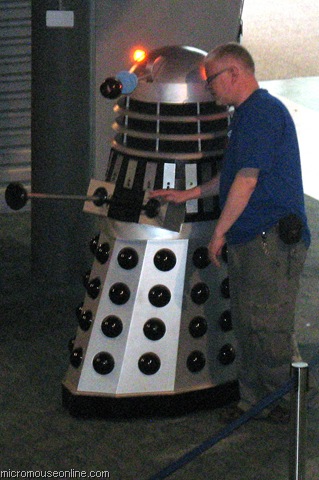
I have just returned form the Rise of the Robots event at the National Space Centre in Leicester. Just one of many specially themed weekends they hold, this proved a great success for exhibitors and guests alike. Visitors were able to experience a variety of robotic experiences from the mayhem of Robot Wars to the more genteel charm of a range of walking robots made by David Buckley. Naturally, there was room for micromouse. The space tie-in was provided by the presence of a particularly scary set of Daleks…
Stars of the show were probably the Daleks and the various Doctor Who fans present. It seemed that everywhere you went there was a Dalek – often chasing or being chased by thoroughly entertained (or alarmed) children. Small groups of children could be seen trailing after the Doctor to assist him in his task of battling the evil enemy. Somehow, I just couldn’t help grinning when ever I saw one. You could be minding your own business and suddenly, out of the corner of your eye, you would catch sight of a Dalek gliding ominously by. "Wow! A Dalek!" The thought came unbidden into your head. Years of conditioning from watching Doctor Who since childhood give Daleks a really menacing air. I saw a good number of adults secretly sidle up to one and try to find out more. As it was not possible to tell if it was occupied, this occasionally resulted in the familiar Dalek shrieks and suitably surprised victims. If you fancy making your own, visit the Project Dalek Site where you can download plans and talk to other builders.
The centre of the main museum exhibition area provided the perfect location for a robot wars arena and regular battles were held throughout the weekend. Some familiar names from the televised Wars were setting about each other with typical enthusiasm and appropriate violence. Nearby a school team demonstrated their prowess with Lego Mindstorms robots playing football on a very convincing digital football pitch.
A special exhibition area had a range of activities. David Buckley had a remarkable collection of robots he has built over a good number of year. David creates marvelous robots from apparently simple materials. Easy-to-program controllers, radio control servos and plywood come together to make walking robots that fascinated everyone who saw them. See for yourself here: David Buckley
Across the room were the Ant Weight Robot Wars machines. These are radio-controlled robots that are miniature versions of their full-sized cousins in the main arena. Although small enough to sit in your hand, you wouldn’t want to get too close to one when it is in action. Displaying a ferocity that totally belies their size, these robots tear around their miniature arena inflicting surprising damage on each other and everything they touch. Find out more: Antweights and Robot Combat.
Next to them were the minisumo teams. Minisumo pits fully autonomous robots against each other in a circular area. These robots have to find their opponent and push it out of the arena. This is a mixture of cunning and brute force although the aim is not the violence of the robot wars competition. Opponents are pushed out so plenty of grip and strong motors are key to doing well. It is acceptable to to have a wedge or scooped front to try and lift the opponent off the floor and break their grip but flipping and any kind of weapons are forbidden. Good sensors and fine motor control are needed if the robot is to be able to locate and home in on a moving target that definitely does not want to be found. Plenty of information can be found at the minisumo.org.uk site.
Last but not least was the micromouse area. We brought along a maze and about a dozen micromice. My new mouse, Decimus, was there as well as most of its predecessors all the way back to the very first mouse I built that was able to find the centre of the maze. Derek Hall brought along MouseX and its successor as well as some of the PICone maze solving mice. The maze, several AIRATs and a surprising array of other robots and equipment were brought by Tony Wilcox of the Technology Innovation Centre (TIC) in Birmingham. The micromouse competition is, of course, the focus of this site so have a good look around if you want to find out more.
All in all the weekend was a great success. We hardly had a minutes break as a stream of inquisitive children and their parents stopped by to find out more about the various competitions and the robots involved. All the visitors had the opportunity to get closely involved by operating the robots, modifying the maze and generally having a good fiddle and poke at everything. I for one quickly learned not to underestimate the average 11-year-old when it comes to getting to grips with what we were all up to and there were some very searching questions. Many parents also seemed very interested and I am sure that there will be more than a few people giving some though to how they might get involved in building robots.
Our hosts, the National Space Centre were excellent. We were well fed and watered throughout the weekend and the staff always helpful and responsive. We shall certainly be interested in attending a similar event in the future.
Robotics in the Curriculum
All fools day it may have been … but not at the Open University headquarters today in Milton Keynes. The ‘Robotics in the Curriculum’ event was attended by a variety of people from the commercial and education worlds. Looking for ways to develop the use of robotics in education, there was plenty of experience to be shared. I was there showing off micromouse and the related schools competitions to pretty well anyone who would stand still long enough to look interested…
The very professional looking stand was really that of Duncan Louttit of Swallow Systems. He is very active promoting schools micromouse competitions. These are introductory level event. There are two in particular that are popular. The F1 drag race requires an autonomous robot to perform a high-speed run along a 7m track, following a white line down the centre. This appears a simple, brute-force event but has a few subtleties to catch you out. The current speed record is 2.5 seconds and last years’s winners have apparently set themselves 2 seconds as their target. If you do some sums, this is quite a challenging target. Why so tricky? Well, the robot time is measured as it crosses the finishing line but it must not then overrun the 1.2m area beyond that or it incurs a penalty that will effectively disqualify it. Couple that with the need to steer the robot accurately at 4m/s or more and you have a competition that is easy enough for anyone to have a go while being tricky enough to require some real skills to win. The other popular event is the wall-follower contest. This takes place in the same maze as the normal micromouse and has two classes – contact and non-contact. For the former, mice require physical contact with the walls to guide them around the maze. Non-contact mice may well find they bump into the walls but are designed to navigate the maze without having to touch a wall. This event attracts quite a few entries and produces some really interesting designs. It potential low-tech approach and ready availability of cheap materials makes if very attractive to the beginner or the hard-pressed school. A good design can be made for £10 with ample scope for development.
Also present were Derek Hall and Jim Chidley. Derek was pointing at Mouse X and reminding everyone that is is the current UK champion. Don’t worry, I have plans for that. Jim was showing off his kit mouse. This design is remarkably simple. It uses a pair of PicAxe processors and is a full maze-solving micromouse. There has been plenty of discussion about what a minimal maze-solver might require. Jim wasn’t satisfied with discussion so he went out and made one. It is an elegant design that anyone could build. Watch a video of it here:
I had a very interesting chat with Paul Foster of Microsoft who was demonstrating some of the huge variety of possibilities available with Microsoft Robotics Studio (MSRS). Having looked several times at this software suite, I learned more in ten minutes talking to Paul than I would have in ten hours staring at a monitor. For the kind of robotics involved in micromouse, MSRS has some limitations. Chief among which seems to be the reliance on some kind of Windows platform for the target system or good communications with a Windows host. However, Paul mentioned the mini-ITS and pico-ITX devices. The pico-ITX is essentially a PC on a board 100mmx75mm. This is almost the exact size of the average maze-solver and raises the interesting possibility of doing development work, including 3D simulation on your PC followed by implementation on an autonomous platform. Now, of course if the run-time of MSRS had a stripped-down version that executed in a simpler virtual machine – like JAVA or the Lego NXT – that would be interesting.
The First Lego league organiser was right next to us. That looks good – a world-wide competition that apparently attracts a couple of hundred entries form UK schools alone. You can’t beat a bit of corporate sponsorship to help these things along. We did agree though that it seems a real shame for there to be so many robot related activities and events that are al happening with little or no interaction. Essentially, they are competing for the attentions of hard-pressed teachers.
I have used some of the older Mindstorms kit and even though I found the programming interface to be a real pain to use, I can see why their kit is attractive. Out of the box, you get a bunch of hardware, most of which is familiar to the user and pretty intuitive to use. It is a rare individual who has never played with Lego. Coupled with that is a range of curriculum support material which is ready to use and, of course, the resources of a huge company to provide support. Teachers simply don’t have time to develop all these materials from scratch. This is nothing new. Teachers have always relied on other people to produce at least the outline of a curriculum or scheme. A good textbook is often the core of many a teaching scheme and with good reason. Now, of course, the Goverment seems to want to mandate more and more of the content of the curriculum but with little evidence of understanding how that should be done. I think robotics in the curriculum will only really take off when there is a good range of relevant, ready-to-use material and a clear place for it in the school timetable. And that does not mean allowing the likes of Microsoft to dominate (sorry Paul).


Add to Google