Tag Archives: マイクロマウス

All Japan Micromouse Contest 2011 Dates

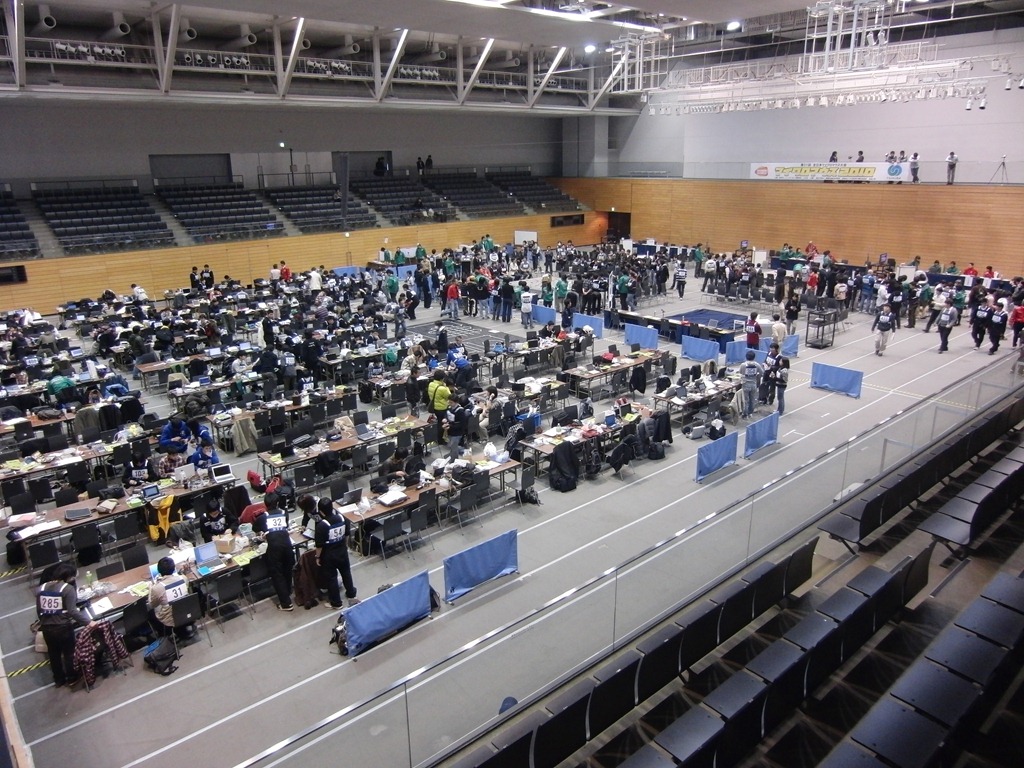
The New Technology Foundation have announced the dates of the 32nd All Japan Micromouse Tournament. The event will be held in Tsukuba on Friday 18th November 2011 to Sunday 20th November 2011. Full details on the NTF web site.
Continue reading

Posted in Micromouse | Tagged | 5 Comments

Measuring Moment of Inertia

The moment of inertia of a micromouse is a useful number to know. It tells you how easy or hard your mouse will be to turn and lets you calculate an appropriate value for the angular acceleration during the lead-in and lead-out of the turn. Indeed, you may find out the upper limits or what your mouse can achieve. the race is, after all, won in the turns they say. So, how can you find out what the moment of inertia is for your mouse?

One way is to calculate it. Simple shapes have easy to understand moments of inertia. You can find  a good set of examples on this wikipedia page. here are plenty of simple geometric shapes and their moments of inertia. However, I don’t suppose your mouse corresponds to any of those shapes. It turns out that moment of inertia is all about how far the mass or masses of an object are from the centre of rotation. For example, imagine a short rod with a couple of weights at the end. If the rod were suspended by its mid-point so that the rod were horzontal, you could spinn the rod around fairly easily and stop it fairly easily. Now use the same weights but at the end of a rod that was twice as long. This longer rod would be harder to get spinning and harder to slow down. The further the mass is from the centre, the higher the inertia.

This observation is critical to good micromouse design. Two mice, each of the same weight, but having their mass distributed differently will perform differently. To calculate the moment of inertia of your mouse, you would have to weigh all the component parts, measure or calculate their distance from the centre of the mouse and add up all the individual moments of inertia to come up with a total for the mouse. This is clearly not going to be easy to do and the result will be an estimate at best. You could, for example, work out the contribution of the motors quite easily but what about all the components on the main board? A good mouse design will place as much weight as possible close to the centre. Many builders work hard to get the moment if inertia as small a possible.

Since it is relatively hard to accurately calculate the moment of inertia, how about measuring it? This turns out to be surprisingly easy. You may have seen clocks that, instead of a swinging pendulum, have a set of weights that rotate around a vertical axis instead. This is an example of a torsion pendulum. The object that you want to get the moment of inertia for is suspended from, typically, a wire that can twist. If you start it off with a twist, it will oscillate back and forth with a period that depends upon the moment of inertia of the object and the stiffness of the wire – and nothing else.

You might like to find out more about torsion pendulums at one of these pages:

Making your own torsion pendulum is quite easy. Essentially, the key component is a piece of piano wire about 1m long. Steel guitar strings should work well. String, fishing line and copper wire will all work but they are quite lossy and the oscillations will damp down quite quickly. For best results, you need something that is not too stiff so that the oscillations are relatively slow. This improves the accuracy. Apart from the suspension wire, you need a cradle to hold your object under test. That cradle will have its own inertia so you must first calibrate your equipment.

For my experiments, I made a imple frame to hold the mouse and some test massess for calibration. It is importat that you are able to mount the objects as closely as possible to the rotational axis of the setup.

Torsion Pendulum

The wire used to suspend the frame is fixed to the top of a door frame so rotation is only possible by the wire twisting. the equation describing the oscillation of this type of pendulum is very simple:

torsion pendulum equation

Where k is the spring constant, J is the moment of inertia of the suspended mass and T is the period of oscillations. Apart from the mouse, we have two unknowns – k and the inertia of the frame. We can work both out by doing a couplel of calibration runs. I took  a couple of weights – steel and aluminium discs – that I had in the garage. These are placed on the frame and ten complete oscillations are timed to the nearest tenth of a second. Divide this by ten to get the length of one period to about one hundredth of a second. Since I know the mass and dimensions of my objects, and I have two of them, I can calculate the total inertia of the system with each of the weights and use that to find the value of k and the inertia of the frame. The latter is easy because, as long as the test objects are carefully placed, the total inertia of the system is the sum of the inertias of its components and I know the moment of inertia for the test weights very accurately. Test the accuracy of your experiment by working out the inertia of a third object that you can accurately calculate the true inertia of.

Once you are happy that the setup is working, it is relatively straightforward now to place your mouse carefully and centrally on the frame and measure the time for ten complete oscillations. Now that you know the stiffness of the spring and the inertia of the frame, it is easy to calculate the moment of inertia of your mouse. So esy in fact that it took less time to make the frame, do the calibration and measure the inertia of my two mice than it did to write this page.

For the record, my results are:

Decimus 1:
mass = 174g
moment of inertia = 125.6 x 10⁻⁶ kgm2

Decimus 2:
mass = 112g
moment of inertia =   99.3 x 10⁻⁶ kgm2

Without getting carried away with analysis, I estimate that the accuracy is better than 5% and, with good experimental technique and electronic timing could easily be improved to about 1%

If you work out the moment of inertia of your mouse, I would be glad to see the results in the comments. Especially if you can compare a measured result to a calculated result.


Continue reading

Posted in Micromouse | Tagged | Leave a comment

All Japan Micromouse 2010 Results

The results for the 2010 All Japan Micromouse Contest have now been published:

http://www.ntf.or.jp/mouse/micromouse2010/2010result_m-classi-cexpert_final.html

Continue reading

Posted in Japan | Tagged | Leave a comment

Japan 2010 Qualifying

CIMG3034This is where the fun really begins. Contestants arrive for qualifying day at the All Japan Micromouse Contest. One contest will be decided completely today, the others have a qualifying phase which determines who goes through to the final tomorrow…

The action takes place at the Capio – a spacious and well-equipped venue in the middle of TSukuba. Several contests are staged this weekend with a large number of machines entered. The obvious focus will be the micromouse in various forms but there is also the Robotrace line follower contest and the microclipper event where micromice are fitted with gripper arms to manipulate cans placed in the maze.

The micromouse contest is made up of several classes. The freshman class is for ‘beginners’. I believe this to mean entries that have not won any other event. In that class this year, there are 121 entries. With each being allowed 7 minutes, it takes all day to work through the contestants – even with a second maze opened up in the afternoon. This class runs straight through with the winner being decided on the day. Results and maze details for this and the other events should become available at the end of Sunday.

The micromouse classic expert class is where I was entered. This had 75 entrants chasing perhaps 16 places in the final on Sunday. As well as the runners today, a further nine mice had already qualified by winning regional contests earlier in the year. The classic event runs on two identical mazes at the same time to get through the number of entries in a sensible time. With several mouse builders entering more than one mouse, the organisers try to arrange for the double entries to run at different times. It can be quite tricky to keep track of what is going on. I forgot to put my mice through scrutineering. Here they verify that it is within the size constraints and photograph each mouse – probably to ensure that each entry really is a unique mouse. As it approaches your turn to run, you have to join the queue on the seats to one side of the maze and shuffle along until it is your chance to have a try.

CIMG3071

Each contestant gets to wear a tabard (bib) with their entry number on it. This is really helpful since you can tell at a glance where your are in the running order and not all of the entrants speak Japanese. Because of the language difference, it is important to watch very carefully what is going on. Again, this year, I managed to infringe some rules. First by not indicating to the judges when I wanted to take a crashed mouse out of the maze and then by not understanding that lifting the mouse out from the start cell counts as a run. There are only five runs allowed and I used two just by picking up my mouse to see why it would not start. All this was explained to me by the announcer who had very good English and acted as interpreter.

CIMG3099

As it turned out none of this made any real difference for me. The problems setting up the mice on the previous day proved too much. D1 seemed unable to see walls ahead and kept driving into them so, after three runs, I retired gracefully. When Decimus 2 had its turn on the other maze a little while later, things looked a little better. D2 has a modest explore speed and, other than one narrow scrape made its way confidently to the goal in about 1 min 16 sec. So that was the first hurdle over and a great sense of relief. After reaching the goal, D2 will explore the rest of the maze until it believes it has the shortest route. Here is here it went bad. In the far corner of the maze, near to the route it would have to take, D2 failed to detect a wall. After hitting the wall, it carried on for a few cells but then stopped. If I were more alert, I would have recognised the symptom but it didn’t register with me at the time. I remembered, this time, to signal appropriately and collected the mouse to do a restart.

After placing the mouse in the start square, I signaled and pressed the appropriate buttons and … nothing. Another quick press of the buttons and still nothing. I was really puzzled by then. One of the key indicator LEDs had not come on so I picked up the mouse to see better. Nothing. Put it down and try again. Nothing. Getting panicky by now, I picked up the mouse once more thinking there must have been a major failure. At this point, I had my little instructional chat from the charming announcer and was told that I now had only two runs left. This break in my chain of thought let me realise what must have happened. After the contact, the maze must have had an extra wall added in the vicinity of the route to the middle. In the far corner was a couple of cells that both routes had to pass through. With an extra wall here, there was no route and D2 is programmed to simply stop moving if it has no route. Once I realised that, I cleared the maze memory and started again. With only two runs and not much time left, I would have to explore to the goal and hope for one fast run. The first part of the plan worked very well. D2 repeated its exploration in the same time and set out to find a better route. The second part of the plan failed right there as D2 hit the same wall again and walled itself in. There was no point in continuing so I retired.

All this made me think again about different strategies. One option suited to the Japan rules is to explore to the goal and stop. You can retrieve your mouse with no penalty and take it back to the start. Now it would be possible to do a speed run with the route that you already know exists and then look for others. This would have got me one fast time.  Such a strategy is open to abuse though. If you can see that the mouse has already found the optimal path, it could be told not to do the subsequent exploration and switch straight into speed run mode. It is common to see Japanese contestants change setting on their mouse between runs.

It also occurs to me that the mouse should never add a wall to a cell that has already been visited and confirmed. I don’t know if it would have helped here as the mouse was probably lost by the time it made the error.

My fellow travellers, Harjit Singh and David Otten fared rather better I am very glad to say. Harjit had been working really hard on his mouse – Zeetah V, literally up to the last minute. This is normally a good way to be sure of disaster but Harjit is very good at what he does and he was rewarded with a good run to the middle and a recorded time of about 55 second. This was his major goal and so he was not too upset not to have been able to do a speed run although I am sure he will have asked himself , as we all do, what if…? I will leave Harjit to write up his own experience if he wants to.

CIMG3072

Dave Otten’s mice, MITEE 11 and MITEE 13, were the solid, smooth runners we expected to see and performed very well. I understand that M11 has run here a number of times before but M13 is brand new and running in its first contest. If you enter multiple mice and both get times low enough to qualify, you may be asked which entry you would like to have run in the final. Dave chose M13 because it is newer. An inspection of the scores showed that both mice got best run times within 20ms of each other. They are very different so this was quite surprising. Anyway, Dave is through to the final and Harjit and I will be keen observers. With nothing else to worry about, we can concentrate on enjoying the show.

CIMG3085

What with trying to keep track of what I had to do, there was not much chance of following the other contests but tomorrow, I hope to be watching carefully to see how everyone does. We get to see the pre-qualifiers like Kato-san for the first time and, from the odd bits of runs I have seen, we should be in for another exciting final.

As well as the micromouse classic, the other events should be pretty interesting. There are signs that the line follower designs are beginning to converge to a more common format and there are some really remarkable half-size mice. The lightest of these weighs only 11g. That is one tenth of the weight of D2. I will also have some details of a remarkable vision guided mouse.

CIMG3038CIMG3039CIMG3040CIMG3049

CIMG3090CIMG3106CIMG3128

Continue reading

Posted in Japan | Tagged | 3 Comments

Japan 2010 Practice day

CIMG3016Friday is practice day. Well, half day would be more accurate. In the afternoon, the venue is open and the mazes and practice circuits are laid out for anyone to test their robot’s basic functions. Everyone is busy setting up, making sure things work as they should and getting a good look at the other entries. Since we had the morning spare, we went an watched the Real World Robot Contest first…

After the qualifying session on the Thursday, we were down to, I think, about 35 entries for the final. A healthy session of speeches got the event off to a good start and the onlookers gathered around the start gate for the first robots to set off. The course runs over 1.1km and includes a couple of interesting challenges on the way. The departure of the first robot immediately cleared the crowd somewhat as people began to follow its progress. We hung around a while to see more starters and to let the onlookers dissipate a little more. Robots are released every five minutes and speeds vary a lot so it was not long before there was an early overtaking opportunity to watch.

The robots expect to encounter obstacles. They can expect those obstacles to be moving. What is seemed they might not have expected was for the obstacle to apparently be running away. Mostly, the robots will follow essentially the same path and deal with obstacles as they find them. When you come up behind a slower robot, it will be moving away from you. Now that is a bit of a problem. Overtaking requires considerable forward planning. In an open environment, it would be easier but how could the robot know what is the other side of the one ahead. It is just like driving behind a slow lorry in fog. What to do? At intervals around the course, there are places where the robots are compelled to stop for traffic or pedestrians. These places seemed to be the only real overtaking opportunity for many robots. In lots of cases, the slower robot was on a different path or would stop for its own reasons. Then it was easy enough to get by.

CIMG3001

After lunch in the food hall at the bottom of Q’t, it was time to head over to the Capio building to see if the mouse would work. This year, I have two – Decimus 1 (D1) and Decimus 2 (D2). D2 is a simple evolution of D1 and it won the UK contest in June. In spite of spending a lot of time on new code in the autumn, that didn’t work out so it will run from the same code that it had in the summer. I probably won’t invest more time in the codebase for these mice and will instead concentrate on the new mouse using  the STM32 processor.

First job is to test the sensors. D2 has an elaborate calibration method that I now greatly regret and it took several attempts to get consistent setting. It is still over sensitive and will probably need adjusting again tomorrow but, for now it will have to do. D1 gave me odd results which turn out to be a dry joint on a component almost buried under the light shield. This had the effect of killing the left diagonal sensor. After a hunt around, I found a kind soul who let me use a soldering iron and I did what I could but I may simply have pressed it into place rather than fixing the joint. There is no way to know so it will have to run as it is.

All this took so long that neither mouse has had the chance to do a full run. Tomorrow will be really busy and there is no access to the full-size maze so I will just have to hope for the best. All this messing around also meant that I did not really get a chance to look at many other mice. However, some stories filtered back and here should be some really interesting stuff about tomorrow.

The Saturday session is qualifying. Only the top 20 (I think) mice go through to the final along with those that have qualified by virtue of being winners in the regional contests. With two mice to run, I shall have to keep my wits about me as they are not likely to be run sequentially. On the other hand, I have it easy. Beng Kiat has two of everything it seems. Two classic mice, two half-size mice and two line followers.

CIMG3002CIMG3003CIMG3007

CIMG3015CIMG3018CIMG3019

Continue reading

Posted in Japan | Tagged | Leave a comment

Japan 2010 – The Journey Out

The time had come. Get on a plane fly east to see what the the world’s best micromouse builders can produce. It is not all micromouse of course – there are line followers and autonomous metropolitan robots – all sorts of things. This year, I must pay more attention to some of the other contests. It is a fair trip. Door to door was about 22 hours and if you include the time before it is possible to check in to the hotel, it comes to an even 24 hours. Arrival in Tsukuba was at 12:15….

It is probably sensible to take a later flight and arrive in the evening but, flying east is an overnight flight whatever you do so it seems to me you might as well at least arrange to get a half day at the destination end and maximise the opportunities for the whole tourist thing.

CIMG2816

The main part of the journey was on a new Airbus A380. This is a big plane. Really big. While the seats are only a little wider than normal, and the legroom is pretty standard, the window seats are interesting in that the fuselage is at its widest point along the lower deck. The effect of this is to give you about another 20cm of free space between the seat and the window. No good if you like to lean against the window for a bit of a sleep but it makes it all seem very spacious. The flight was AF276 Paris to Narita and it was not overfull. Many found the opportunity to stretch out across three seats. There was another passenger in my row but, with nobody sat next to you, there is plenty of opportunity to move around in search of comfort.

Narita customs and immigration were very quick and efficient – helped by being at the front of the aircraft and among the first half-dozen off. From Narita to Tsukuba is about a 90 minute bus ride. Tickets are purchased from the Keisei line desk in the arrivals lobby and the staff there will tell you the times and bus stop number. You cannot buy return tickets – they are valid only for a specific journey so, if your return journey means an early departure from Tsukuba, remember to get a ticket in plenty of time. It is also not possible to pay on the bus I believe.  While waiting inside the terminal for the bus, I was asked for my papers by the police. This happened last year and then as now, I seemed to be the only one asked. I should like to know why. There are not many western faces to be seen in much of Japan so I guess we stand out a bit. Once safely in Tsukuba, I dropped my bags at the Daiwa Roynet Hotel and it was time for lunch.

CIMG2904

This was from a random restaurant in the Qt shopping centre at the rear of the hotel. Only about £7 and very tasty. Not being entirely sure what to do with the raw egg, I had to try and watch the girl two seats away to see what she did with hers, all the time hoping I didn’t look like I paying improper attention. Whisk it up with some soy sauce and stir it into the rice is what I ended up doing.

While waiting for the hotel to let me check in, I did a little shopping and wandered over to have a look at the afternoon session of the Tsukuba Real World Robot Challenge. For this, teams have to enter an autonomous robot capable of navigating a course around a park and the through the pedestrian areas of Tsukuba, finishing their 1.1km journey inside a building. The session I saw seemed to be a practice and the actual event takes place on the Friday. There is a great deal of variation in the devices entered with some looking very professions and others looking like a toolbox mounted on a RC car chassis. In fact that is exactly what one of them was.

CIMG2927

The robot pictured above motored serenely into the goal and looked, to me at least, to be a very smooth operator. Finally, I got to check in to the hotel, shower, get a hot drink and lie down for a while. In the early evening, David Otten and Harjit Singh from the USA arrived and, after a bit of catching-up chat, we went for a walk around to try and ensure that we would be tired enough to sleep through until breakfast. That shouldn’t be a problem for me as I have been up now for about 31 hours but it is annoying to wake up at 3 in the morning, still over tired but unable to get to sleep.

Tomorrow is practice day at the Capio and we shall get our first look at the new season’s mice. Can’t wait!

Continue reading

Posted in Japan | Tagged | 2 Comments

ROBOtic09 results

On Saturday November 28th 2009, we held out our semi-formal winter event for the micromouse and small robot builder. Held at Millennium Point in Birmingham and made possible by Birmingham City University, this is an ideal opportunity to get in a bit of mid-year competition and size up the opposition before those long winter nights of robot building and tweaking…

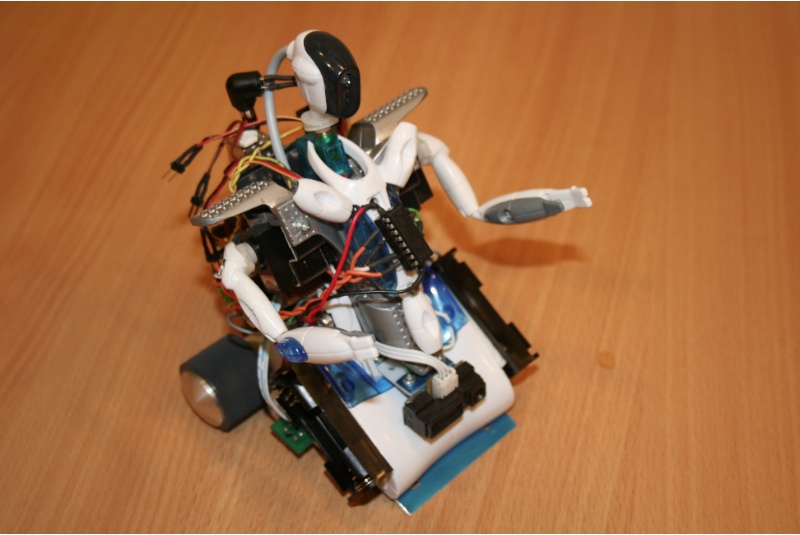
I was not paying as much attention as I might but there was a very gratifying turnout of entrants and spectators from near and far. We had the usual range of maze, related events, the results of which are listed below. Also present again were a number of biped and sumo builders. The photo in the header is of a small robot hacked out of a Meccano Spykee original:

The non-contact wall followers only managed a small number of entrants this time. This is a bit of a shame as anyone who is building a micromouse should give serious thought to making thins one of the stages on the way to a fully functional micromouse.


Non-contact Wall Followers Results
Name Handler Best run Best Score
Topo Bernard Grabowski 24.56 24.56
PIC02 Bernard Grabowski 27.1 27.1
Lefty Ken Hewitt 37.32 40.32
E RAT IC David Hannaford 42.85 51.85
LAZ-E David Hannaford 67.76 70.76

The maze solvers managed a rather more convincing field for the time of year with several entries, old and new. The maze was not without its challenges with a couple of nasty diagonals to negotiate.

Decimus just managed to retain its pride:


Maze Solver Finals Results
Name Handler Best run Best Score
Decimus Peter Harrison
7.69
17.91
Mouse X Derek Hall
9.33
18.36
MouseX2 Derek Hall
9.41
18.55
PICone Jim Chidley
19.97
31.53
Isambard II Martin Barratt
28.81
33.00
PICone Turbo Jim Chidley
17.18
35.80
Thezeus C Alan Dibley
99.14
99.14
Kaasjager Coen Roos
119.7
138.42

Note that, this year, and from henceforth, we have made a small change to the awarding of prizes to ensure that builders with several mice cannot take a disproportionate number of prizes. Hence the best entry by each builder will get the award. In the table above, the best run time does not necessarily correspond to the best score time. For example, Decimus obtained its best score on its second run even though that took 8.15 seconds. The search time penalties are dominant here and the UK contest really demands a slightly different strategy. If Decimus had only taken about 15 seconds longer in the search before starting it speed run, its score time would have been worse than that of Mouse X.

The route taken by Decimus covered 41 cells at a nominal average speed of 0.96 m/s. This is not a reliable figure since it is calculated by assuming that each cell covers 180mm. This is clearly not the case in practice when mice are running diagonals. Interestingly, this is less than half the speed of the top Japanese and Singaporean mice right now. We still have a way to go.

Actually Decimus was pretty lucky to get a good run at all. the on-board display clearly shows that it added a wall in the lower right cell. That wall could just as easily have been added in a place that would have stopped it running altogether. Evidently, I need to do some adjustments.

The final event of the day was the time trial. This is a simple run around the outside of the maze with all the walls put in place. This has become quite popular and is a good test of the stability and accuracy of a maze solver.

Time Trials Results
Name Handler Best run Best Score
Decimus Peter Harrison
7.41
7.41
PICone Turbo Jim Chidley
13.21
13.21
Snoopy Chloe Hall
13.58
13.58
CheddarByte Peter Walker
16.50
16.50
Lefty Ken Hewitt
28.76
28.76
Thezeus D Alan Dibley
28.95
28.95
E RAT IC David Hannaford
29.86
29.86

As this is a simple race, the best score is the same as best time


Time to take a bit of a break from mouse building. Christmas looms large. Plenty of work in the new Year though. I am looking forward to being able to go to the APEC contest at Palm Springs in February.


Continue reading

Posted in RoboTIC | Tagged | Leave a comment

Japan 2009 Micromouse Rules

The 30th All Japan Micromouse Contest will run from Saturday November 21 to Monday Noember 23rd 2009 in Tsukuba. The organisers have released the rules for this event and there are a couple of surprises…

The new event is the half-size contest. All the linear dimensions are half those of the traditional contest. You can skip straight to the published rules (in English) here: http://www.robomedia.org/micromouse2009/rulehalf-EN.html The first surprise I noticed was that the maze is described as being up to 32×32 cells. The actual size was not set. Thus, it would be foolhardy to make any assumptions about the actual size in your code. This shouldn’t be a problem as long as you have enough memory in your controller and can make sure your code does not rely upon the magic of 8 bit quantities wrapping around to zero when looking up maze data. The other surprise was that the target region was in a position to be determined at the start of each contest. I assume it would be given in time for entering into the mouse but the target could be almost anywhere and need not be the traditional 4×4 cell block. The rules state that the coordinates of the entry point would be given although that seems slightly ambiguous. Here I suppose they mean the coordinates of the cell which has the timing gate in it. This may imply that there is only one possible entrance to the target area. Timing for the Japanese contest appears to have been better described. Last time I looked at their rules, they appeared to be much the same as the UK rules which have been largely unmodified for a good number of years. Now it is much more clear that the score is based solely on fastest run time. Provision is made for tyre cleaning without incurring a touch penalty. No penalty is associated with a long search time. To encourage fast searching, there is a prize specifically for the fastest mouse to find the target. It seems the main event is still considered to be the full-size contest. At least, that is how it is described in the rules. This is now called Micromouse Classic and you can jump to the rules here: http://www.robomedia.org/micromouse2009/ruleclassic-EN.html

Continue reading

Posted in Micromouse | Tagged | 1 Comment

UK Micromouse 2009 videos

jpgs-078Video from the UK Micromouse 2009 competition is now available on YouTube. These cover the maze solver and non-contact wall follower classes.


Jim Chidley PicOne


Derek Hall MouseX2


Barry Grubb BT


Martin Barrett Isembard 2nd


Derek Hall MouseX practice run


Peter Harrison – Decimus


Wall Followers

Continue reading

Posted in UK contest | Tagged , , | 4 Comments

UK Micromouse 2009 University Pictures

bigimageBirmingham City University hosts the UK micromouse competition and without its generous support, the event would be a poor shadow of it current self. Here are some pictures taken by the University’s photographer.

There were a lot of pictures taken but these are the ones I was sent… [flickr-photoset:id=72157621150537616,size=m]

Continue reading

Posted in UK contest | Tagged , | Leave a comment