Micromouse book
Categories
Recent Comments
Meta
Popular Posts
- Simple ADC use on the STM32 (4,106)
- STM32 Arm-Cortex bootloader (2,803)
- STM32 USART basics (2,704)
- All Japan Micromouse 2011 – finals (2,011)
- STM32F4 – the first taste of speed (1,690)
- Micromouse Book (1,589)
- Nokia 3410 LCD on the STM32 (1,337)
- CodeSourcery GNU Toolchain for the ARM on a Mac (1,145)
- Bit Banding in the STM32 (1,047)
- ARM STM32 JTAG (973)
Blogroll
-
Upcoming Events
Tag Archives: friction
Pinion interfering with the tire
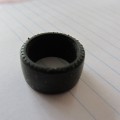
When I applied power to the motors on Zeetah VI (ZVI) for the first time, the motors seemed to struggle and the PWM value to get the wheels to rotate seemed higher than usual. Since this was my first four … Continue reading
Posted in Hardware, Micromouse
Tagged file, friction, interefere, interference, pinion, sand, tire
5 Comments
Tyres and traction
It is true, I am losing my grip. A while ago I posted a link to a Japanese site demonstrating the grip available from a particular micromouse. A common way of doing this is to lock the wheels and place the mouse on a tilting surface. As the slope of the surface is increased, the downforce available to the tyres is progressively reduced until the mouse slips. Part of the downforce is lost due to the angle alone and is proportional to the tangent of the slope.
Thus, at 45 degrees, the coefficient of friction needed to prevent slip is 1. There is another factor at play though. As the lope increases, more of the weight of the mouse is transferred to the skid on the downward side of the mouse. This reflects what happens when the mouse is under braking or acceleration. Reaction torque transfers some force to the skid. A long mouse with a low centre of mass fares better here.
With Decimus I have been having trouble when the acceleration gets much above 3m/s/s. This is disappointing as I was aiming for at least 4m/s/s. The tyres are the most obvious reason for problems at high accelerations so I built a little test rig to see how much grip was available:
I am using Mini-z tyres. They are a bit hard to find in the UK and come in a bewildering variety of materials and patterns. these are 8mm wide slick intended for the front wheels of mini-z 1/18th scale electric racers. I have a few of these and they all appear pretty similar so the rig is intended to find the best set I have. A pair of mini-z wheels are bolted to a small meccano frame so that they cannot turn. batteries add some weight and a harness allows me to attach a spring balance. The whole assembly weights 100g and has the weight almost exactly over the wheels.
The spring balance lets me measure the force needed to start the wheels slipping. Before the test, a section of maze is cleaned and the tyres are cleaned of any dust and dirt. Several trials are needed to even out any variations.
It turns out that my very best tyres begin to slip at about 43g. My worst tyres, which do not feel much different to the good ones start to slip at about 16g! If I take into account weight transfer when the mouse is running and the possibility of dust on the maze floor, it seem I am best limiting my acceleration to 3m/s/s until I can get some better tyres.
I just ordered some replacements. These are a set of GPM slicks said to be 8 shore hardness and a set of Shimizu slicks at 15 shore hardness. I chose the GPM because they were the softest I could find and the Shimizu because several folk in micro racing forums rated them as particularly good.
Derek Hall, owner of MouseX, is fond of balloon rubber over the outside of his tyres. I tried that over the top of my ‘good’ set and found no significant difference.
Astonishing level of grip.
I like to check out the various Japanese micromouse builders’s site to see what they are up to. Google translations sometimes make some sense but it is very hard work. I was looking on this blog the other day: R & D daily: work out. The author (whose name I cannot work out – sorry) has a picture of his latest mouse sitting on a slope. The slope is at a very steep angle indicating the tyres may have a coefficient of friction with the maze surface of 2 or more. Pretty impressive. This particular mouse has four wheels. It is a wheelchair drive mouse but with two wheels per side. I would expect that to cause problems with the tyres having to slip around corners but so far it seems to go pretty well. Check it out. Look for the pictures and links to videos.
Add to Google