Micromouse book
Categories
Recent Comments
Meta
Popular Posts
- Simple ADC use on the STM32 (4,106)
- STM32 Arm-Cortex bootloader (2,803)
- STM32 USART basics (2,704)
- All Japan Micromouse 2011 – finals (2,011)
- STM32F4 – the first taste of speed (1,690)
- Micromouse Book (1,588)
- Nokia 3410 LCD on the STM32 (1,337)
- CodeSourcery GNU Toolchain for the ARM on a Mac (1,145)
- Bit Banding in the STM32 (1,045)
- ARM STM32 JTAG (973)
Blogroll
-
Upcoming Events
Tag Archives: inertia
Working on Zeetah V again
After a break of a month, we’ve started working on Zeetah V again.
I have started work on ZV again in preparation for APEC 2011 in March in Ft Worth, TX. The goals for that contest are to do speed runs with diagonals.
My friend, Pierre, who made all the mechanical parts for ZV, has been coming up with ways to make ZV more competitive.
After he took a look at the pictures from the All Japan Contest, he decided that we should replace the Al hubs and spur g
ear on ZV with plastic ones.
ear on ZV with plastic ones.Currently, each Al hub, spur gear and bearing set weigh 6.4g. The replacement using plastic pieces and new bearings will be either 2.0g or 2.3g. This change will reduce the mouse weight by 8g (8%) but more importantly reduce the rotational inertia by around 11%.
There are two different hub styles he is considering – see image below. The one in his hand is the lighter one but he is concerned about it wobbling because the two bearings to support the hub are very close to each other. There is another plastic hub which has a cylinder shape coming out of the center which should have less wobble.

Another option Pierre is considering is making the hub and gear out of one piece. I believe Peter does this. I’m concerned about the meshing and also the strength of the teeth but we will experiment and find out.
We are also going to reduce the diameter of the hub by 1mm this is because I was too conservative and the current clearance between the PCB and the maze floor is too much. I think we are still being too conservative but don’t want to push things right now. This change should reduce the lateral and longitudinal weight transfer by 1% each. Is this change significant? Not at the performance level the mouse is currently at but I’ll take every little bit of help.
Line Follower First run
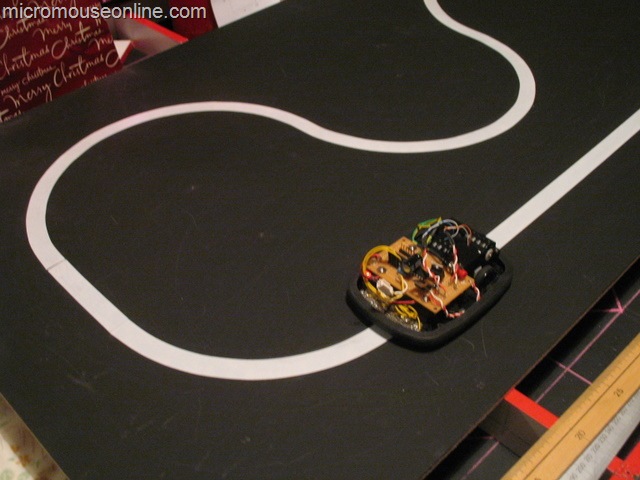
All the bits are together and the processor code tested. Bob should know when he is on track and how far out he is when he is off track. Time to get him running on the test track…
For this first run, the control was kept very simple. If the position error is positive, Bob needs to turn right. If it is negative, he needs to turn left. Turning is accomplished by removing power from the appropriate motor.
Well, that isn’t too impressive is it. Not that I expected much better at this stage. A couple of things worry me a bit though. The amount of wobble on the straights indicate that there is a lot of inertia and plenty of overshooting. The control loop is running at about 200 Hz and the frequency of overshoot is a couple of hertz. When I put Bob together, I though that having the wheels at the rear and the sensors way out in front would be a good thing. However, the batteries are well ahead of the wheels as well and have quite a bot of mass. The other thing is that, in the turns, the robot is only just turning fast enough to keep up with the turn even though one motor is off most of the time. Apart from the expected oscillations, this may also be due to the fact that the motor is driven from single transistor so there is little braking available. Once the PWM is turned off, the motor can freewheel so turning is not as sharp as it would be if the motor were braked. It may be necessary to replace the motor driver with a bridge to get better control. Finally, it is much noisier than I anticipated. Not serious in terms of performance but it wakes up the dog and, trust me, it is better to let this particular sleeping dog lie.
Add to Google